the pin factory runs backwards
· originally published on LinkedIn →
this is a translation of the spanish original · read the original →
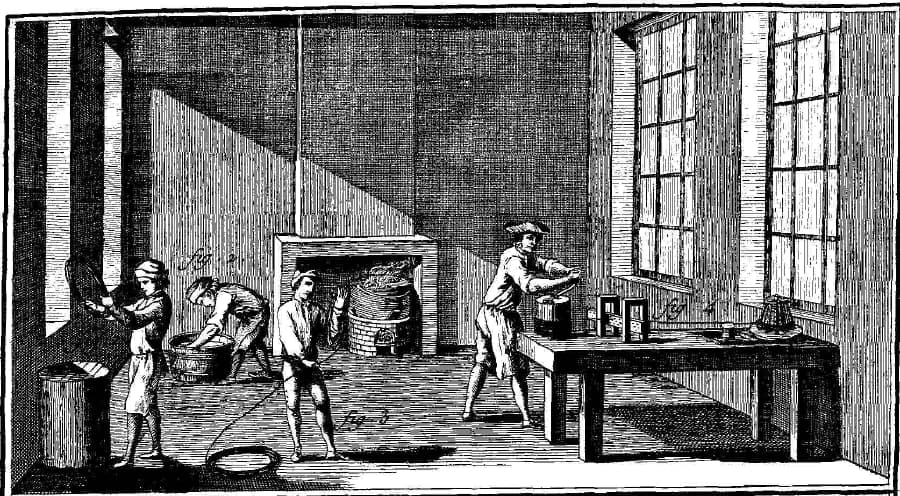
in 1776 adam smith opened the wealth of nations with a pin. one untrained worker, he wrote, could make perhaps one pin a day. divided into eighteen distinct operations, ten workers could make forty-eight thousand. specialization was the engine. it built the factory, the firm, the org chart, and eventually the quiet border between the people who decide what to build and the people who build it. we call them product managers and individual contributors. the line between them is two hundred and fifty years old.
it is dissolving.
the cost of execution is collapsing. a controlled trial at github and mit put developers on a coding task: the ones with an ai assistant finished 55.8% faster, seventy-one minutes against a hundred and sixty-one. eighty-four percent of developers now use these tools or plan to. at microsoft, satya nadella says ai writes twenty to thirty percent of internal code. at anthropic, leadership puts it closer to a hundred. cursor, the editor most of them work in, went from a hundred million dollars in revenue to two billion in about thirteen months. the fastest any business software has ever scaled.
when the marginal cost of building falls toward zero, the team you needed to build collapses with it. maor shlomo took base44 to two hundred and fifty thousand users and sold it to wix for eighty million, with eight people. midjourney crossed eight figures with a skeleton crew and no venture money. sam altman expects the first one-person billion-dollar company within the decade. the unit of production is no longer the team. it is the individual with leverage.
this is the part smith did not foresee. when one person armed with machines can run all eighteen operations, the efficient move is to recombine them into one person. the division of labor runs backwards. and the scarce input stops being execution. it becomes judgment.
naval ravikant said it before the models were any good: in an age of permissionless leverage, judgment, not work, determines success. code works for you while you sleep. now the code writes itself, and what is left is the deciding. what to build. whether it is any good. when to stop.
garry kasparov learned this against a machine. after deep blue beat him in 1997 he organized freestyle chess, humans paired with engines. the 2005 tournament was won not by grandmasters and not by supercomputers but by two amateurs with ordinary laptops and a better process. weak human plus machine plus better process, he wrote, beat a strong computer alone, and beat a strong human plus machine plus worse process. leverage flows to whoever orchestrates best. not to whoever knows most.
so the roles are folding into each other. openai shipped codex with two product managers, one designer, and forty engineers across a dozen surfaces. cursor reportedly runs with a single pm. keith rabois put the strong version on a podcast this year: the idea of a pm makes no sense in the future, the skill is more like being a ceo, what are we building and why. the individual contributor stops being a pure producer and becomes a manager of agents. which is to say, a product manager. the convergence is not coming. it is already the operating model of the companies building the tools.
here is where the optimism should stop and breathe.
the same force that empowers the builder is quietly breaking the thing that produces builders. you learn judgment by doing the execution. you develop taste by making bad things and watching them fail. the apprentice work, the first rung of the ladder, is exactly what the machine now does. matt beane, who studies this at santa barbara, is blunt: we have started a war between technological productivity and human skill, and skill is losing.
the data has teeth. signalfire, looking at six hundred and fifty million professionals, found big tech cut new-graduate hiring twenty-five percent in 2024 and more than half against pre-pandemic 2019. new grads are now seven percent of big tech hires. thirty-seven percent of managers said they would rather use ai than hire a gen z employee. meanwhile they raised hiring of people with two to five years of experience. the market did not close. it deleted the entrance.
mit ran eegs on people writing with chatgpt and found what they called cognitive debt: lean on the external system and the effortful thinking that builds the skill simply does not happen. addy osmani, at google, names the other half. ai gets you seventy percent of the way, and the last thirty, the edge cases, the security, the production weight, is the hardest part and does not scale. and metr, testing experienced engineers on their own large codebases, found them nineteen percent slower with the tools, while they were certain they were faster. people are bad at judging their own leverage.
then there is the flood. slop was merriam-webster's word of the year. lowering the cost of production does not raise the median. it buries it. most of the empowered will produce noise.
so the thesis needs a knife taken to it. ai does not make everyone a great builder. it removes the execution bottleneck for the people who already have judgment, and it raises the price of that judgment, because nothing else is scarce anymore. for them this is the best moment in the history of building. one person, full leverage, no permission required.
for the generation behind them it is an open wound. we automated the apprenticeship and kept the requirement that you arrive with taste already formed. nobody has solved where that taste now comes from. residencies, ai mentorship, hiring for range over depth, these are guesses, not answers.
smith's pin factory took a whole person and split them into a fraction of a task. the machine is putting the person back together. the question is whether we still remember how to make the kind of person worth putting back together.
sources
- pin factory and the division of labor: adam smith, an inquiry into the nature and causes of the wealth of nations (1776), book i, chapter i.
- 55.8% faster on the coding task: sida peng, eirini kalliamvakou, peter cihon, mert demirer, "the impact of ai on developer productivity: evidence from github copilot," arxiv:2302.06590 (2023).
- 84% of developers use or plan to use ai tools: stack overflow developer survey 2025.
- microsoft 20-30% of internal code written by ai: satya nadella, public remarks, 2025 (widely reported).
- anthropic close to 100%: anthropic leadership statements, 2025 (reported).
- cursor $100m to $2b in ~13 months, fastest-scaling business software: secondary reporting, e.g. thenextweb, "cursor in talks to raise $2b at $50b valuation" (2026). reported, not audited.
- base44, 250k users, sold to wix for $80m with eight people: industry reporting, 2025 (e.g. grey journal). reported.
- midjourney, eight figures with a skeleton crew, no venture money: industry reporting. headcount disputed (~40 to ~160), hence "skeleton crew" rather than a number.
- sam altman, first one-person billion-dollar company: altman, public remarks. forecast, not fact.
- naval ravikant, "judgment, not work, determines success" and permissionless leverage: naval ravikant, the almanack of naval ravikant (eric jorgenson, 2020) and naval on x, 2018 / 2025.
- kasparov, freestyle chess and "weak human + machine + better process": garry kasparov, "the chess master and the computer," the new york review of books (2010); expanded in deep thinking (2017).
- openai codex team composition (two pms, one designer, ~40 engineers): industry reporting, 2025.
- cursor running with a single pm: industry reporting. reported.
- keith rabois, "the idea of a pm makes no sense in the future": lenny's podcast, 2026. verify exact wording against the recording before quoting.
- matt beane, "a war between technological productivity and human skill": matt beane, the skill code (2024); see also "learning to work with intelligent machines," harvard business review (sept 2019).
- big tech new-grad hiring down 25% (2024) and >50% vs 2019, new grads 7% of hires, 37% of managers preferring ai over a gen z hire, 2-5 year hiring up 27%: signalfire, state of tech talent report 2025. note: ai causation is contested. an lse working paper (lambert & schindler, "the broken ladder") attributes much of the entry-level decline to remote work once controlled for.
- "cognitive debt": nataliya kosmyna et al., "your brain on chatgpt: accumulation of cognitive debt when using an ai assistant," mit media lab, june 2025.
- the 70% problem: addy osmani, "the 70% problem: hard truths about ai-assisted coding" (2024).
- experienced developers 19% slower: joel becker et al., "measuring the impact of early-2025 ai on experienced open-source developer productivity," metr, arxiv:2507.09089 (july 2025). context-specific: experts on familiar codebases averaging 1m+ lines.
- "slop," word of the year: merriam-webster, 2025.